
How Email and SMS Work Together in Klaviyo
Learn how Klaviyo email and SMS should work together across campaigns, flows, segmentation and reporting without creating more noise.
How Email and SMS Should Work Together in Klaviyo
Adding SMS to Klaviyo does not automatically create a multichannel strategy. If email and SMS are planned separately, sent to the same audiences and used to communicate essentially the same message, the customer simply receives more marketing rather than a better experience.
The real opportunity comes from understanding what each channel is good at, where it belongs in the customer journey and how behaviour in one channel should influence what happens in the other. When that is managed properly, klaviyo email and SMS can support the same commercial objective without competing for the customer’s attention.
Email and SMS Should Have Different Roles
Email and SMS naturally lend themselves to different types of communication. Email gives brands space to explain, educate and build a more complete story around a product or offer, while SMS is most useful when brevity and timing matter.
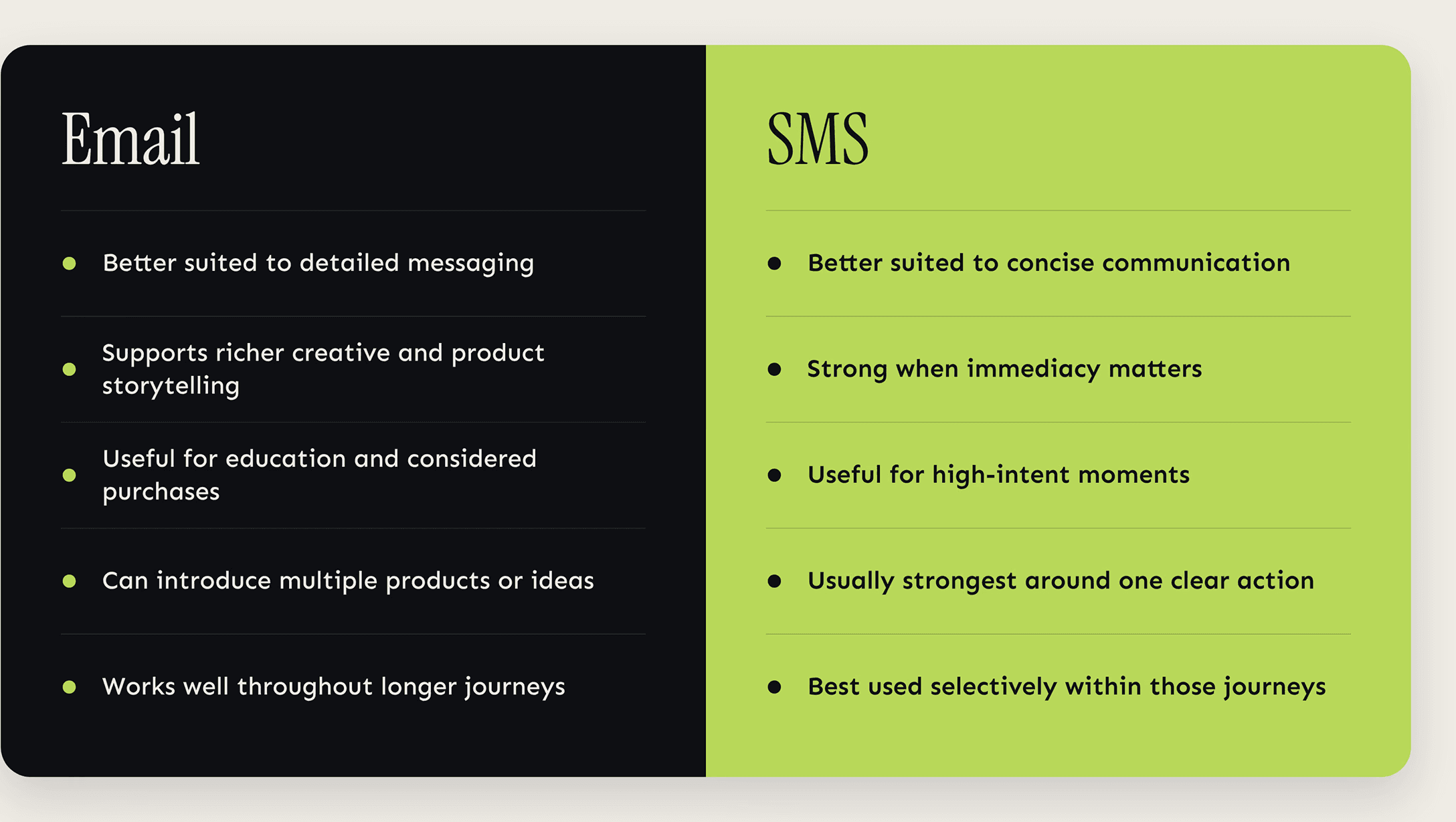
This distinction sounds simple, but it changes the way the calendar should be built. Instead of finishing an email campaign and asking whether an SMS should also be sent, the team should decide what the customer needs at each stage and then choose the channel that is best suited to that job.
For example, email might introduce a new collection with photography, product details, customer benefits and several ways to explore. SMS could then support the launch later when early access opens, a popular product returns to stock or a genuine deadline is approaching.
Both channels are supporting the same campaign, but they are contributing something different.
Start With the Customer Journey, Not the Channel
One of the easiest ways for email and SMS to become disconnected is to plan them in separate calendars. The email team fills its schedule, SMS is added afterwards and nobody looks closely enough at the combined experience of the customer receiving both.
A better starting point is the customer journey itself. For each important moment, consider what the customer currently knows, how much intent they have shown, how much information they need and whether timing changes the value of the message.
A customer who has just discovered the brand may need a detailed welcome email explaining the product range. Someone who has visited the same product three times and then abandoned checkout probably does not need another brand introduction. A short reminder may be much more appropriate.
That is where Klaviyo becomes particularly useful because behavioural data from email, website activity, purchase history and SMS can all contribute to the same customer profile. The channels should respond to that shared information rather than operating independently.
Email Is Usually Better for Depth. SMS Is Better for Immediateness
There is no universal rule that says a particular message must always be email or always be SMS, but thinking in terms of depth versus immediacy provides a useful starting point.
Email is generally the stronger choice when the message requires context. Product launches, buying guides, customer stories, comparisons, educational content and considered purchase decisions often benefit from the space email provides.
A higher-value product might require several pieces of reassurance before someone feels comfortable buying. Email can explain materials, features, reviews, delivery, guarantees and product differences without forcing everything into a few lines.
SMS becomes useful when the timing of the message is part of its value. That could be early access opening, a promotion genuinely ending that evening, a previously viewed product returning to stock or a high-intent customer leaving checkout incomplete.
The aim should not be to squeeze every email into 160 characters. It should be to identify the moments where a short, direct message is genuinely more useful.
Email and SMS Campaigns Need One Calendar
If a brand is actively using both channels, campaign planning should show email and SMS together.
The customer does not experience an “email department” and an “SMS department”. They simply experience communication from the brand. A promotional email at 10am followed by an almost identical text at midday therefore feels repetitive, regardless of how separately those messages were planned internally.
A combined calendar should show the audience, objective, product or offer, channel, timing and any relevant exclusions for each send. It should also make recent communication visible so that the team can see how much contact an individual customer might realistically receive.
A launch week might therefore look something like this:
Monday: launch email introducing the collection
Wednesday: product or category-focused email
Friday: SMS to customers who have demonstrated high intent but have not purchased
That sequence gives each touchpoint a reason to exist. Simply sending the Monday and Wednesday campaigns through both email and SMS would add volume without necessarily adding value.
Klaviyo Segmentation Should Determine Who Receives SMS
SMS is a more direct form of communication and usually carries a cost per message, which makes broad, indiscriminate sending particularly difficult to justify.
Having SMS consent does not automatically mean someone should receive every SMS campaign.
Useful Klaviyo segmentation for SMS can be based on behaviours such as recent browsing, checkout activity, purchase history, product category interest, customer value and engagement with previous email campaigns.
Imagine an email announcing a new collection is sent to 60,000 engaged subscribers. Rather than following it with an SMS to every opted-in contact, the SMS audience could be narrowed to customers who clicked the campaign, browsed the collection, have not yet purchased and have not recently received another SMS.
The difference is significant. The message is no longer another broadcast. It becomes a response to demonstrated customer interest.
This is one of the strongest reasons to manage email and SMS within the same Klaviyo account. Activity from one channel can inform targeting in the other.
SMS Should Be Added to Flows Selectively
The same principle applies to Klaviyo flows. The fact that a flow can contain both email and SMS does not mean every journey should.
In a welcome flow, email will usually do most of the work because a new subscriber still needs to understand the brand, products and reasons to buy. SMS could support a specific moment, such as delivering an incentive or reminding a subscriber before it expires, but it should not simply repeat what the email has already said.
Abandonment flows are often better candidates for SMS because intent is clearer. A customer who has added a product to basket or reached checkout has already moved much further through the buying journey.
A sequence might begin with an email that restores the product and reminds the customer what they were considering. A second email could add social proof, product detail or reassurance. SMS could then be reserved for selected customers who remain incomplete and where a short reminder adds something useful.
Post-purchase journeys require even more restraint. A recent customer does not need additional marketing simply because the transaction makes them eligible for another automation. Email usually provides the better environment for product education, care instructions, cross-sell and review requests, while SMS should be used only where there is a clear reason for the added immediacy.
Contact Frequency Has to Be Reviewed Across Both Channels
One of the easiest mistakes to make is reviewing frequency separately.
Three campaigns in a week may look reasonable when looking at email alone. However, the same customer may also enter a browse flow, receive a cart email and receive two SMS messages during that period.
From the customer’s perspective, that is seven touchpoints.
This is why frequency management should consider the complete customer experience. Teams should regularly review whether flows overlap with campaigns, whether recent purchasers should be excluded from certain messages and whether someone who received an SMS needs to receive the next campaign as well.
There is no single correct send frequency for every ecommerce brand. Purchase cycle, audience engagement, category and customer expectations all matter. What is important is having visibility over the combined volume of communication.
Without that visibility, adding another channel can quickly become synonymous with simply sending more.
SMS Should Not Become the Discount Channel
Because SMS works well for urgency, it can easily become over-reliant on offers.
Sale starts now.
10% off today.
Final hours.
Last chance.
Those messages have a place, particularly during important trading periods, but if almost every text depends on a discount, subscribers quickly learn what to expect from the channel.
SMS can also support new launches, restocks, early access, relevant replenishment reminders, VIP communication and other moments where directness is genuinely useful.
We saw this clearly when working with a luxury watch retailer where SMS became a meaningful part of the wider retention programme rather than an occasional promotional add-on. Across 2025, the channel generated more than £383,000 in attributed revenue and contributed more than 20% of attributed Email & SMS revenue during peak season.
The important lesson is not that every brand should aim for the same revenue split. Different categories, databases and customer journeys will produce very different results. What mattered was that SMS had been integrated into campaigns and customer journeys throughout the year, so it was already established when Black Friday and Christmas arrived.
Testing Should Look at the Relationship Between Email and SMS
Testing individual messages is useful, but some of the more valuable questions are about sequencing.
Does an email followed by SMS perform better than SMS followed by email? Does SMS improve the conversion rate of a particular abandonment journey? Do customers who clicked an email respond differently to a follow-up text than customers who did not engage at all?
These tests help answer a more important question than whether one message had the strongest click rate. They help determine where SMS actually adds value to the journey.
The evaluation should therefore include more than direct SMS revenue. Depending on the test, it may be useful to review overall conversion rate, revenue per recipient, total journey revenue, email unsubscribes and SMS opt-outs.
In some cases, the conclusion may be that email alone works perfectly well for a particular audience. That is still a useful result.
The objective is not to prove that both channels should always be used. It is to understand when using both improves the outcome.
Reporting Should Reflect the Whole Customer Journey
Attribution can encourage teams to treat channels as if they are competing for credit.
A customer might receive an email, browse the site, enter an abandonment flow, receive an SMS two days later and then purchase. It is tempting to reduce that journey to whichever channel received the final attribution.
Operational reporting still needs channel-level revenue, but strategic reporting should look at how the journey worked as a whole.
Useful questions include:
Which message started the interaction?
Which behaviours indicated increasing purchase intent?
Where did SMS enter the journey?
How many touchpoints happened before conversion?
Did SMS improve the performance of the sequence?
Were any of the messages unnecessary?
How did opt-out and unsubscribe behaviour change?
This creates a much more useful picture than simply asking whether email or SMS generated more revenue that month.
What Happens When Email and SMS Are Managed Separately?
The immediate consequence is usually repetition, but the longer-term problems are more important.
Audiences can receive duplicate promotions, SMS costs can increase without a corresponding improvement in conversion, opt-out rates can rise and flows can begin competing with campaigns. Reporting also becomes harder to interpret because the channels are being measured independently even though customers experience them together.
It can also lead to SMS becoming increasingly promotional because nobody has defined a wider role for the channel.
Most of these problems are not caused by poor copy or poor creative. They are coordination problems.
Are Your Email and SMS Strategies Actually Connected?
A few signs suggest they may still be operating separately:
Major email campaigns automatically receive an SMS equivalent
Email and SMS are planned in different calendars
SMS is primarily used for discounts
Most SMS sends go to the same broad audience
Email engagement rarely influences SMS targeting
SMS behaviour does not influence email segmentation
Flow and campaign frequency are reviewed separately
Reporting compares email revenue against SMS rather than examining how they contributed together
A more mature approach gives each channel a clear role and uses customer behaviour to determine when that role becomes relevant.
Email can provide the depth needed to educate, inspire and build confidence. SMS can add directness when timing or intent makes that communication more valuable. Klaviyo provides the infrastructure to connect the two, but the quality of the result still depends on how thoughtfully the account is managed.
For ecommerce brands already using both Klaviyo Email and SMS, the opportunity is often not to increase the number of messages being sent. It is to improve how those messages work together.
If your brand is already active across both channels but they still feel like separate programmes, Evernue can help review the account, customer journeys and campaign structure to identify where better coordination could make the experience stronger.
Blog
Read more articles


Who do you work with?
We primarily partner with established 7–8 figure ecommerce brands that want a dedicated Klaviyo team. Whether you're founder-led or have an in-house marketing team, we become an extension of your business, taking ownership of your Klaviyo account.