
Managing Klaviyo vs Sending Emails | Evernue
Managing Klaviyo goes far beyond campaigns. See what proper Klaviyo management includes across flows, segmentation, testing and reporting.
The Difference Between Sending Emails and Managing Klaviyo
Sending campaigns from Klaviyo is not the same as managing Klaviyo.
A brand can have campaigns going out every week, a welcome flow switched on and healthy-looking open rates, while large parts of the account receive almost no attention. Proper Klaviyo management means taking responsibility for the entire channel, not simply keeping the send calendar moving.
That distinction becomes increasingly important as an ecommerce brand grows.
Sending Emails vs Managing Klaviyo
The simplest way to separate the two is this:

1. Klaviyo Campaign Planning Should Start Before the Week of the Send
Reactive email usually sounds something like:
Sales are soft this week. Can we send something tomorrow?
Sometimes a short-notice campaign makes sense. It should not be the operating model.
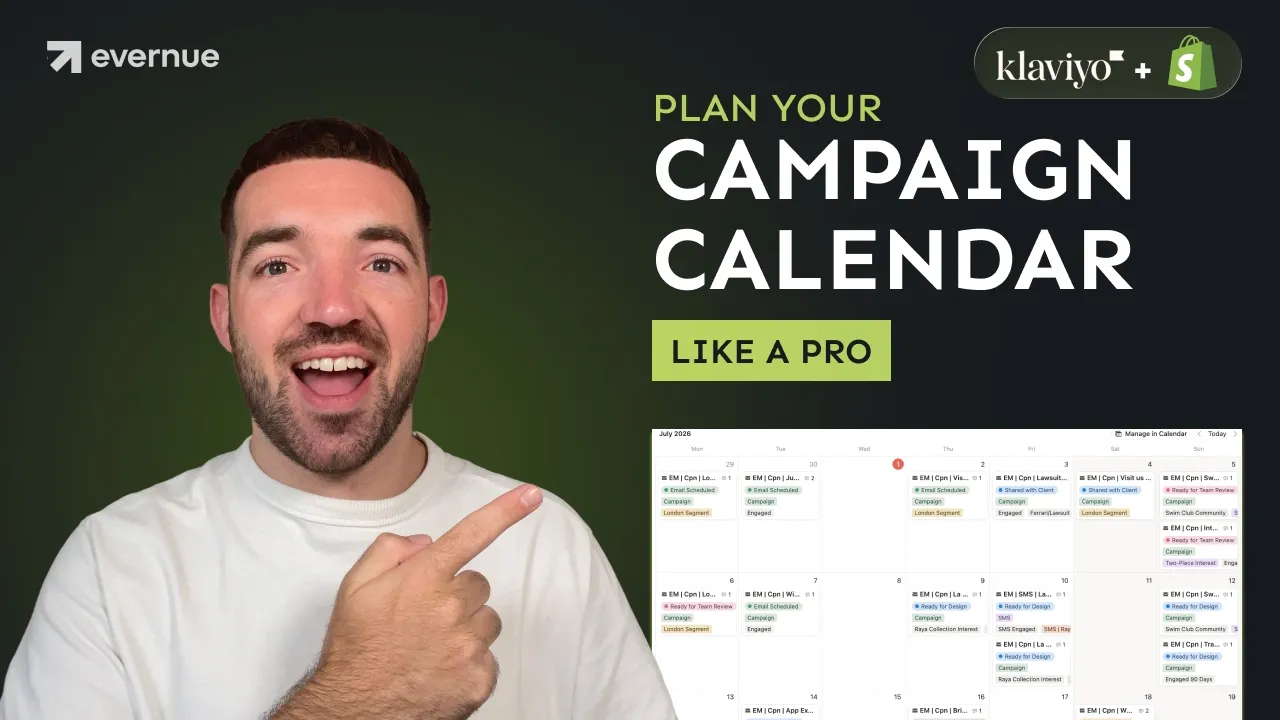
We generally want campaign calendars mapped at least a month ahead. That creates enough visibility to connect email with:
Product launches
Promotions
Restocks and stock levels
Paid media activity
Seasonal priorities
Website changes
Brand campaigns
Commercial targets
It also makes the actual campaigns better.
When the team can see the full month, it becomes easier to avoid sending the same product, offer or message repeatedly. You can deliberately balance launches, education, product discovery, social proof, editorial content and promotional activity.
One of the biggest differences between sending emails and managing Klaviyo is therefore planning with context.
A campaign should have a reason to exist beyond filling a slot in the calendar.
2. Klaviyo Segmentation Goes Beyond “Engaged” and “Unengaged”
Many accounts technically use segmentation. The problem is that the segmentation often stops at two groups: engaged and unengaged.
That is useful for protecting deliverability, but it tells you very little about why someone is likely to buy.
A more developed Klaviyo segmentation strategy might distinguish between:
A customer who buys every month
Someone who purchased twice but has missed their normal repurchase window
Someone repeatedly browsing one product category
A high-value customer whose engagement is declining
A recent purchaser who should be excluded from a promotion
Someone who viewed a product several times but never added it to basket
Those customers should not automatically receive identical messaging.
A practical place to start is to ask three questions before every campaign:
Who is most likely to care about this message?
Who should not receive it?
What behaviour can we use to make the audience more specific?
Better segmentation does not necessarily mean creating 100 segments.
It means using the customer data already inside Klaviyo with more intention.
3. Klaviyo Flows vs Campaigns: One-Off Sends Are Only Half the Picture
Campaigns respond to the calendar.
Flows respond to customer behaviour.
That makes the distinction between Klaviyo flows vs campaigns fundamental to a properly managed account.
A mature flow architecture will usually cover more than welcome and abandoned cart. Depending on the business, that could include:
Welcome
Browse abandonment
Cart abandonment
Checkout abandonment
Post-purchase
Review request
Cross-sell
Replenishment
Second-purchase journeys
Winback
Back in stock
The important part is not simply having these flows live.
They need maintenance.
Products change. Offers change. Creative becomes outdated. Purchasing patterns shift. New customer data becomes available.
A flow that still generates revenue can still be underperforming.
Klaviyo’s abandoned cart benchmark data illustrates why these journeys deserve proper attention. Across the brands analysed, abandoned cart flows averaged a 3.33% placed order rate and $3.65 revenue per recipient, while the top 10% reached a 7.69% placed order rate. (Klaviyo)
That is why we would rather review the timing, logic, exclusions, individual message performance and customer journey than simply say, “the flow is making money, so leave it alone”.
For example, one Evernue-managed luxury ecommerce account generated more than £151K from its welcome flow alone. The lesson is not that every welcome flow should produce that number. It is that automated journeys deserve the same level of strategic attention as campaigns.
4. Email Deliverability Needs Managing Before Something Goes Wrong
Deliverability is often invisible until it becomes a problem.
That is too late.
Good email deliverability management means watching the signals that influence whether future campaigns reach the inbox:
Bounce rate
Spam complaints
Unsubscribe rate
Engagement
List quality
Sending behaviour
Suppression
Authentication and infrastructure
Klaviyo currently classifies a bounce rate below 1%, unsubscribe rate below 0.3% and spam complaint rate below 0.01% as healthy. (Klaviyo Help Center)
These are not metrics to check once a quarter. If a campaign produces an unusual spike in unsubscribes or complaints, investigate the audience, message and send frequency while the information is still useful.
List hygiene also should not mean periodically deleting thousands of contacts without understanding why engagement fell.
Look first at acquisition source, frequency, segmentation and what subscribers were originally promised.
Deliverability is rarely disconnected from strategy.
5. Testing Should Create Learning, Not Just Winners
An A/B test is only useful if you know what you were trying to learn.
Testing “Subject Line A vs Subject Line B” every week without documenting the result can create plenty of activity and very little improvement.
A better testing process looks like this:
Hypothesis: Benefit-led subject lines will produce stronger purchase intent than offer-led subject lines for this audience.
Variable: Subject line only.
Success metric: Do not stop at opens. Review clicks, placed order rate and revenue per recipient where the sample size allows it.
Learning: Record the result.
Application: Decide where that learning should influence future campaigns.
The same principle applies to:
Send time
Offer positioning
CTA language
Email length
Product presentation
Plain text vs designed creative
Flow timing
Number of messages
Segmentation
Continuous optimisation is not constant change.
It is making deliberate changes, recording what happened and carrying useful learning into the next decision.
6. Reporting Should Explain Revenue, Not Just Display Metrics
An email report full of green percentages is not automatically useful.
Open rate, click rate and attributed revenue tell you what happened. Klaviyo management should also explain why it happened and what the team should do next.
For every campaign review, we want to understand:
Which segment received it?
What was the campaign trying to achieve?
How did it compare with similar sends?
What generated clicks?
What converted?
Which audience performed best?
Did unsubscribes or complaints change?
What should we repeat?
What should we change?
Revenue per recipient is particularly useful when comparing sends to different audience sizes.
A £15K campaign sent to 100,000 people and a £10K campaign sent to 20,000 people tell very different stories.
The same applies to flows. Total flow revenue can hide a weak second email, poor entry volume or broken logic.
Reporting becomes valuable when it ends with an action.
7. Personalisation Is About Relevance, Not Adding a First Name
“Hi {{ first_name }}” is not a personalisation strategy.
The more useful forms of personalisation usually come from behaviour.
For example:
Product interest:
Show products from the category someone has repeatedly browsed.
Purchase history:
Avoid promoting something they have just bought and introduce the next logical product instead.
Customer status:
A first-time purchaser and a five-time customer should not always enter the same journey.
Zero-party data:
If someone told you what they care about through a sign-up form, use that information later.
We have used this approach for considered purchases where the sign-up form asks customers about their priority before they even reach a product page. That answer can then shape the welcome flow, education and product positioning that follow.
The objective is not personalisation for its own sake.
It is reducing irrelevant communication.
The Cost of Not Managing Klaviyo Properly
The cost is not always immediately visible.
Campaigns can continue generating revenue while the account underneath them gradually becomes weaker.
What usually happens is more subtle:
Flows remain unchanged for 12 to 18 months
Segmentation stays basic
Customers receive increasingly repetitive campaigns
Testing stops producing useful learning
List quality declines
Deliverability issues begin appearing
Reporting becomes descriptive rather than actionable
The team becomes increasingly reactive
This creates opportunity cost. There may be revenue sitting inside an unfinished post-purchase journey, customers who could be targeted more intelligently, or high-performing flows that have never been properly reviewed.
The bigger issue is that the account stops progressing.
Are You Sending Emails or Managing Klaviyo?
Here is a quick check.
If several of these are true, the account may be receiving production support without full management:
Campaigns are usually planned less than a week ahead
Most sends use the same one or two segments
You cannot remember when the core flows were last reviewed
Testing happens occasionally but results are not documented
Reporting focuses mainly on opens, clicks and total revenue
Deliverability is only discussed when performance falls
Pop-ups collect an email address but little useful customer data
Nobody clearly owns the optimisation roadmap
There is no regular monthly or quarterly account review
You know Klaviyo is working, but you are not confident it is improving
That final point is usually the clearest distinction.
Sending emails keeps the channel active. Managing Klaviyo keeps the channel moving forward.
At Evernue, we use a simple operating cycle across the account:
Plan → Manage → Review → Improve
Plan what the account needs. Manage the execution properly. Review what customers and performance are telling you. Then turn those observations into the next improvement.
That applies to campaigns, flows, segmentation, pop-ups, testing, deliverability and reporting.
If your team is already sending consistently but the wider account rarely gets this level of attention, it may be worth reviewing how Klaviyo is being managed, not just how often email is being sent.
Evernue provides specialist Klaviyo management for established ecommerce brands that want a dedicated team responsible for the channel. If you would like a second set of eyes on your account, you can book a call with us.
Blog
Read more articles


Who do you work with?
We primarily partner with established 7–8 figure ecommerce brands that want a dedicated Klaviyo team. Whether you're founder-led or have an in-house marketing team, we become an extension of your business, taking ownership of your Klaviyo account.